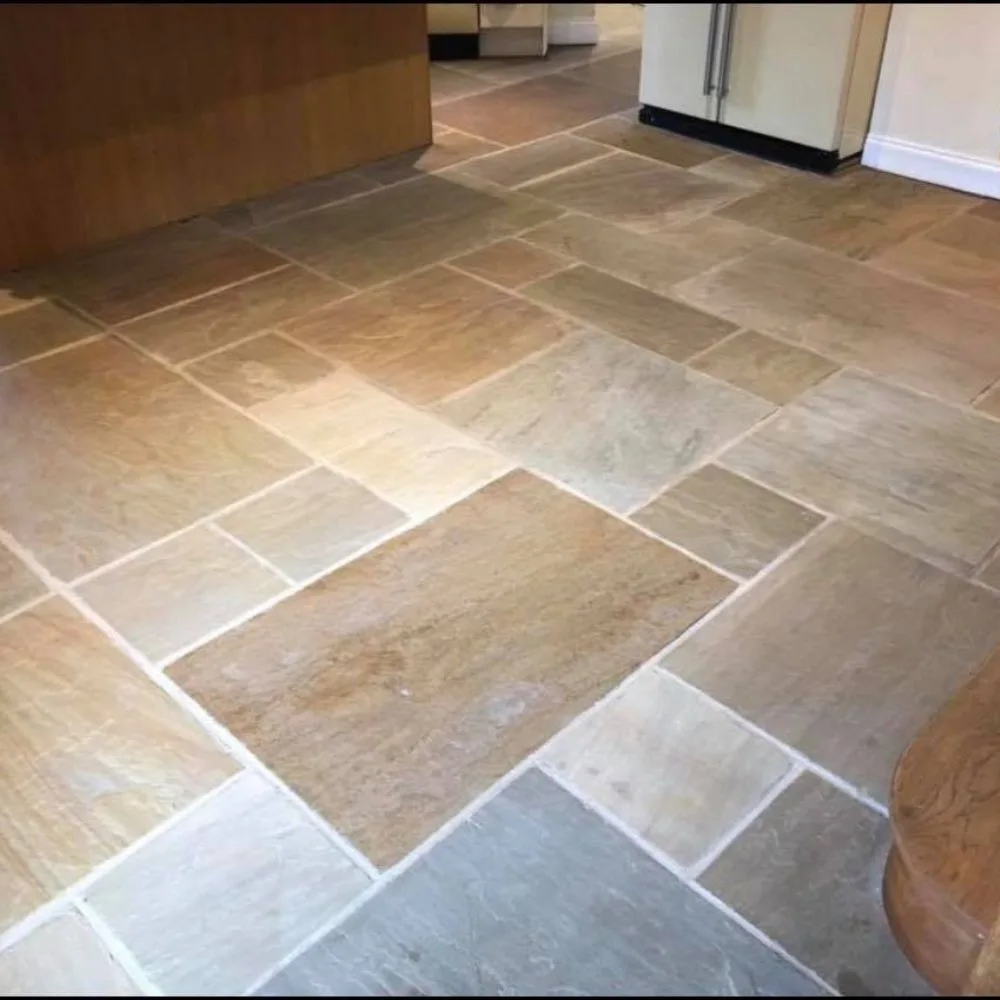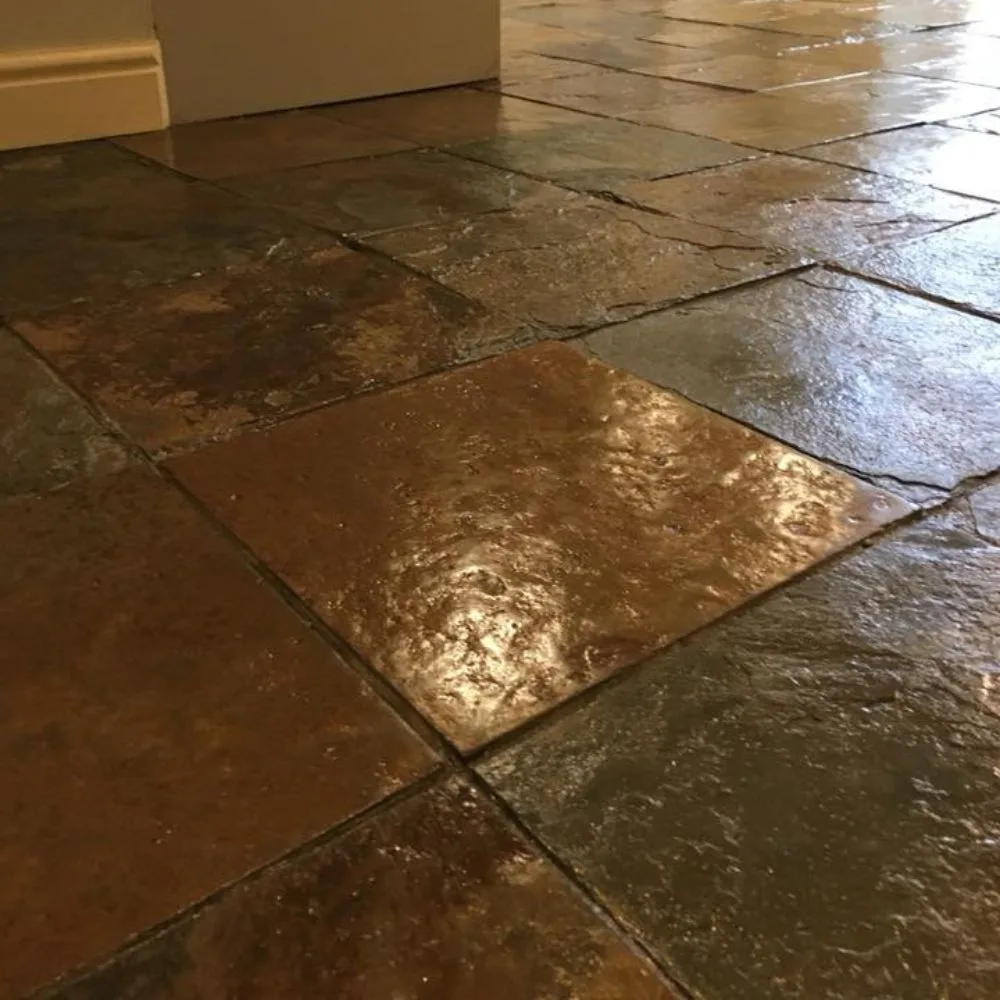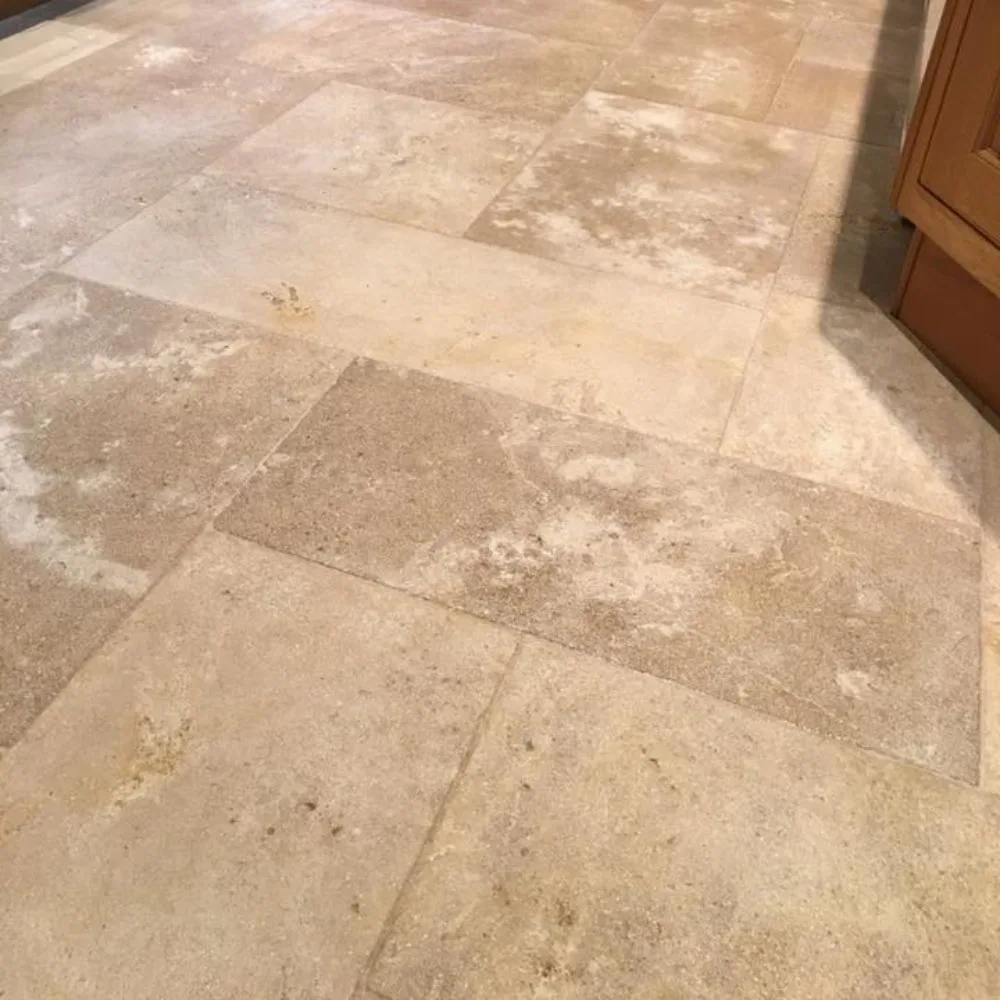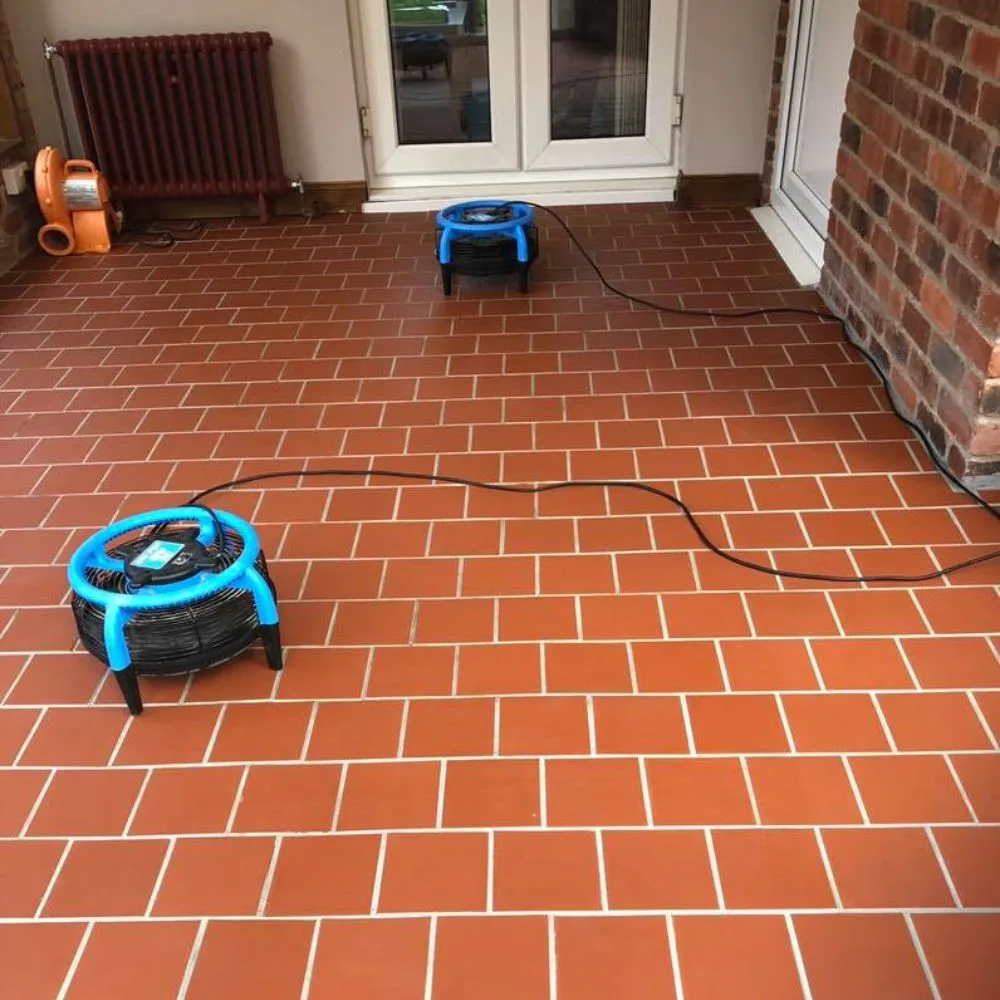
Stand in a kitchen with a tiled floor that has stopped looking clean and look carefully at a single tile. It is almost always fine. Glazed ceramic and porcelain are close to indestructible underfoot.
It is the three millimetres between the tiles doing all the ageing.
Grout is the sponge in the floor
Grout is cement based and, unless somebody sealed it, porous — far more porous than the tiles on either side of it. It also sits slightly lower than the tile surface, so it collects everything that gets pushed across the floor.
A mop makes this worse in a way that is almost comic when you picture it. The mop head skates over the glazed tiles, where there is nothing much to pick up, and the dirty water it is carrying drains into the lowest point available. Which is the grout.
That is why a floor can look worse after mopping than before, and why the lines get darker in a pattern that follows wherever people walk.
The other reasons grout goes dark
Old sealer breaking down. If the grout was sealed at some point, that sealer has a life. As it degrades it goes patchy, and the patches hold dirt unevenly, which reads as mottling rather than even darkening.
Soap and detergent residue. Same story as stone — a film designed to dry shiny, trapping grit.
Efflorescence. White or pale crusty deposits, which is the opposite problem: mineral salts carried up out of the screed by moisture and left on the surface as the water evaporates. Scrubbing it does nothing, because it keeps coming.
Actual mould, in bathrooms and wet rooms. This one is organic and needs treating rather than cleaning.
Cracked or missing grout. Once a line has failed, water gets underneath, and the problem stops being cosmetic.
Telling these apart matters, because three of them do not respond to cleaning at all. That is the first thing Rob is looking at on a survey.
Why the brush and the supermarket bottle stop working
A stiff brush and a spray will shift surface dirt from the top of the grout. What they will not do is get into the body of it, and they will not lift the dirty solution back out — it goes straight back into the line as it dries.
There is also a limit to how much scrubbing old grout should take. Grout is softer than the tile, so an aggressive brush and a strong product erode it. People scrub harder each time, the lines get lower, and the floor collects dirt faster than it did before.
What a professional clean is actually doing
Every job starts the same way: a free, no-obligation visit from Rob, our fully trained floor technician. He carries out a demonstration on a small area so you can see the result on your own floor rather than somebody else's, surveys the floor properly to identify what it actually is, and talks through the finish you want. We will advise — but the decision on the finish is yours.
For tiled floors the work is specialist machinery rather than muscle: a pre-spray matched to the floor, left to work, then mechanical agitation, then the dirty solution rinsed out of the grout line and extracted. Restoring badly neglected floors is largely a question of having equipment that can remove what it has loosened.
Where a deep clean is not suitable — a floor over a suspect subfloor, somewhere that cannot be taken out of use for long, an upstairs room where water is a risk — there is a low-moisture technique that achieves most of the result without putting that water into the building.
Then sealing
This is the step that decides whether you are back here in eighteen months.
A grout sealer soaks into the line and leaves a barrier that slows how fast liquid is absorbed. Understand what that does and does not mean:
- It does buy you time on a spill, so it can be wiped up instead of absorbed
- It does make routine cleaning far more effective, because the dirt stays on top where a mop can reach it
- It does not make grout waterproof, or stainproof, or permanent
- It does not fix grout that has already cracked, crumbled or washed out — that is a repair, before any sealing
- It does not last forever. It wears, fastest where people walk
Sealing dirty grout seals the dirt in. The order matters, and it is one way round only.
When the answer is colouring, not cleaning
Sometimes a floor has been cleaned as far as it will go and the grout is still uneven — bleached in places, stained in others, or simply a colour nobody would choose now.
Grout colouring puts a pigmented coating over the clean line. It evens out the colour completely, seals as it goes, and costs a fraction of re-grouting a floor. On an old kitchen or a hallway it can make more visible difference than anything else available.
It is not right everywhere, and we would rather tell you that on the survey than afterwards.
Keeping grout looking right
- Mop with plain hot water more often than with product
- Change the water before it goes grey, not after
- Wipe spills rather than letting them sit in the lines
- Mats at the doors, as ever
- Get it resealed before the sealer has gone, not years after
Where to go next
- Tile floor cleaning — deep cleaning and grout sealing across Sheffield, Barnsley and Huddersfield
- Stone floor cleaning — if the floor is natural stone rather than ceramic
- Victorian floor cleaning in Millhouse Green, Barnsley — a real job on an original Victorian tiled floor
Book a survey
Floor Angels is a family-run firm, part of Cleaning Angels Yorkshire, and has been restoring floors across South and West Yorkshire since 2007 — Sheffield, Barnsley, Huddersfield, Holmfirth and the villages between them.
Call 0114 288 1937 or 07729 345 458, or send us a message, and we will come out, look at the floor and tell you honestly what can be done with it.